





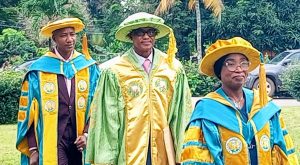
Lawal; Deputy Provost, Dr Mrs. Bridget Olawuyi and Ag. Registrar, Mr Dele Kolawole; at the 2nd Valedictory Lecture of the College delivered by Engr. Noah…in Ibadan on Thursday (3/9/2025)
A Senior Lecturer at the Federal College of Forestry, Ibadan, Engr. Akpan Noah, has described Nigeria’s pulp and paper sector as an untapped goldmine which could significantly boost the country’s economy if properly harnessed.

Noah, an expert in pulp and paper technology, stated this while delivering a valedictory lecture organised by the College to honour him on his retirement from active service on Thursday.
Noah noted that paper in its various forms has remained indispensable, as hardly any home exists without paper in one usable form or the other.
He lamented that most of the privatised primary paper mills in Nigeria have failed to live up to expectations.

“In spite of the noble goals and expected impact of these mills on capacity development and supply of industrial products, the unique potential presented by this industrial sector has not been fully exploited for the socio-economic well-being of Nigeria as a nation.
“Thus, this goldmine remains regrettably untapped to its full potential,” he said.
He listed the challenges against optimal operation of Nigeria’s pulp and paper industry to include policy and institutional failures, technology gaps, financial barriers, unstable power supply, an insecure political environment, and raw material constraints, among others.
He, however, noted that the challenges facing the industry are not insurmountable.
“With coordinated efforts across government, academia, and the private sector, Nigeria can transform its pulp and paper sector from a dormant asset into a thriving engine of sustainable industrial development.
“Nigeria’s pulp and paper crisis is not a failure of resources, but a failure of conversion of these resources. And that is a solvable problem,” he said.
Earlier, the Provost of the Federal College of Forestry, Ibadan, Prof. Ibraheem Lawal, said Nigeria’s pulp and paper industry could drive industrial growth, create jobs, and reduce import dependence if government and research institutions invest in sustainable pathways for revival.
Lawal noted that the topic of the second valedictory lecture of the college was timely and spoke directly to Nigeria’s industrial aspirations, forestry resources, agricultural biomass, and employment challenges.
The Provost noted that while Nigeria is endowed with substantial forest resources, agricultural residues, technical manpower, and a large consumer market, the country has not fully realised the industrial potential of pulp and paper production.
He lamented the paradox of having raw materials and human capital without fully developed value chains, and industrial plants whose operation and competitiveness remain a major challenge.
Calling for a national approach to industrial revival, the provost urged government to provide consistent policies, financial institutions to develop long-term financing, and industry to invest in modernisation.
He added that research institutions must focus on solutions that industry can adopt, while colleges must strengthen technical training and ensure laboratories and workshops remain responsive to industry needs.
“Reviving the sector requires integrated value chains, reliable energy, and strong research-industry collaboration,” Lawal said.

More Stories
NIS EXTENDS UK PASSPORT INTERVENTION TO OCTOBER 3
FG BEGINS ₦18BN SEVERANCE PAYMENT TO EX-NIGERIA AIRWAYS STAFF
ATTACK ON AYILAMO COMMUNITY IN BENUE STATE LEAVES 4 POLICE OPERATIVES DEAD