





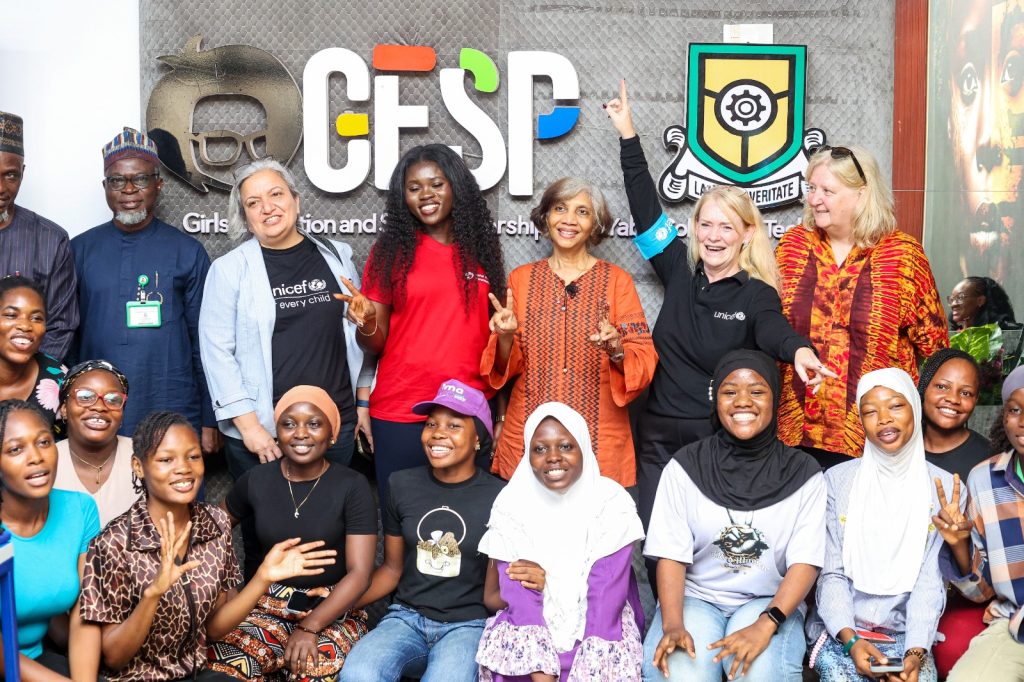
Millions of schoolchildren across 26 states in Nigeria are gaining access to digital education through the Nigeria Learning Passport (NLP), as UNICEF and Airtel Nigeria leverage free connectivity to expand learning opportunities, improve academic performance and equip young people with digital skills.
The initiative, which provides over 15,000 curriculum-aligned educational resources, is enabling pupils and students to continue learning beyond the classroom, with young girls among the major beneficiaries of the digital skills training component.

The UNICEF Nigeria Deputy Representative, Dr Rownak Khan, disclosed this on Tuesday during an assessment tour of selected schools and institutions in Lagos State to evaluate the impact of digital learning platforms and youth skills acquisition programmes.
The delegation visited Senior Government College, Iyana-Ipaja, St George’s U.N.A. Primary School, Ipaja, and Yaba College of Technology, where they assessed how digital learning is shaping educational experiences and skills development.
The programme, stakeholders noted, underscores the role of partnerships in making digital education accessible, particularly by removing data charges that often hinder students from using online learning resources.

The Nigeria Learning Passport is an online, mobile and offline digital learning platform that provides educational resources in English, Hausa, Igbo and Yoruba, covering pre-primary, primary and secondary school levels.
Originally introduced in Nigeria during the COVID-19 pandemic when nationwide lockdowns forced schools to close, the platform was designed to bridge the educational gap created by the closure.
It is now officially hosted by the Federal Ministry of Education, making it part of the country’s public education infrastructure.
Speaking during the tour, Khan expressed satisfaction with the progress recorded by students, particularly the enthusiasm displayed by girls acquiring technical and digital skills.
She commended the collaboration between the Federal and state ministries of education, UNICEF and Airtel Nigeria, identifying free access to the platform as a critical component of the initiative.
“I am very impressed to see how these girls are learning digital skills, and I really would like to thank the Ministry of Education at both the federal and state levels,” she said.
“But our biggest appreciation goes to Airtel Nigeria for this partnership. Airtel has supported us with zero-rating, providing free access so these girls can learn the skills they need to prepare for school and their future careers,” she added.
According to her, the success of the initiative depends on combining data-free access with technical support and collaboration among stakeholders, while keeping students at the centre of the programme.
The partnership with Airtel Nigeria allows students to access the digital curriculum without incurring data charges, thereby addressing one of the major barriers to digital learning in developing regions. The initiative has so far been expanded to over 1,600 schools nationwide.
The assessment also highlighted the growing participation of girls in digital learning, with UNICEF and Airtel stressing the need to ensure that young people are not excluded from opportunities created by technological advancement.
Head of Programmes at the Airtel Africa Foundation, Esi Asare Prah, said digital literacy has become increasingly important in a world being reshaped by artificial intelligence and other technological developments.
She described accelerating digital inclusion in education as a central objective of the foundation, emphasising the need to equip young people across Africa with future-ready skills.
“One of the biggest missions for the foundation is driving faster digital inclusion in education to improve learning outcomes,” Prah said.
“For Airtel as an organisation, digital inclusion is a major priority. We want to ensure that young people across Africa are equipped for the future,” she added.
Prah said one of the most encouraging aspects of the tour was seeing young students, particularly girls, taking full advantage of the opportunities provided by the platform.
She noted that girls had historically faced marginalisation in technology and digital advancement, making their active participation particularly significant.
“It was wonderful to see young girls taking full advantage of the opportunity afforded by the zero-rated Learning Passport. Because they can learn free of charge, they are able to absorb information and, within minutes, develop content from what they have learnt,” she said.
She expressed appreciation to UNICEF and the Federal Government for the partnership, explaining that the Airtel Africa Foundation pursues four core objectives: strengthening digital infrastructure, extending access to underserved rural communities, empowering marginalised groups and promoting long-term educational equity across Africa.
According to her, any young person in Nigeria with an Airtel connection can access the Nigeria Learning Passport free of charge.
Beyond digital skills acquisition, students say the platform is enhancing their academic experience by providing additional opportunities to study and revisit classroom lessons.
Tosin Adeola, head girl at Government Senior College, said the Nigeria Learning Passport had significantly improved students’ academic performance and study habits.
She explained that the platform complements practical classroom training by enabling students to continue learning at home, review lessons and deepen their understanding of difficult topics.
Adeola thanked UNICEF and Airtel Nigeria for supporting the initiative and pledged that students would continue to make effective use of the platform.
With the platform now reaching millions of schoolchildren across 26 states, UNICEF says it is looking to expand its coverage in partnership with government, with the goal of ensuring that every Nigerian child has equal access to digital learning opportunities.
The reach of the initiative reflects the potential of combining educational resources, digital connectivity and institutional partnerships to broaden access to learning.
Its further expansion, however, remains tied to the ability to make digital education accessible to children across the country, including those who still face connectivity challenges.
Through the Nigeria Learning Passport, UNICEF and its partners are seeking to make learning resources available beyond traditional classroom settings, while strengthening students’ academic development and preparing them for future careers.
For students already using the platform, the benefits range from revisiting difficult lessons at home to acquiring digital skills that support their education and future opportunities.
The continuing expansion of the initiative places digital access at the centre of efforts to broaden educational opportunities, with UNICEF and Airtel Nigeria maintaining their partnership to bring more Nigerian children within its reach.

More Stories
BELLS UNIVERSITY HOSTS ENGINEERING LEADERS AS OLUMAYOWA IDOWU LEADS AI-FOCUSED INDUCTION CEREMONY …To spotlight innovation, digital transformation and the future of engineering
Reliable energy, fundamental to industrialisation, employment generation – NSE
NORTHERN SENATORS FORUM CONDEMNS BINARI ATTACK,IN TARABA