




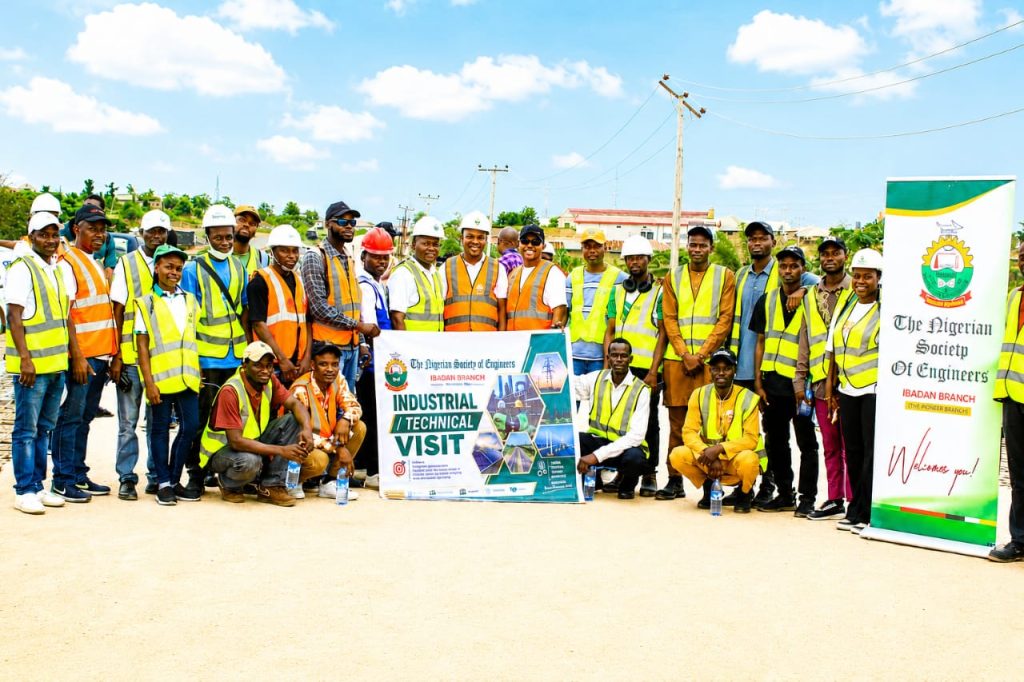
The Chairman of the Nigerian Society of Engineers (NSE), Ibadan Branch, Engr. Ayokunnu Ojedele, has described the ongoing conversion of the Ibadan-Ife-Ilesa Expressway from asphalt to concrete pavement as a bold step toward durable road infrastructure in Nigeria.
The Chairman made this known on Thursday during a technical visit to the project site by members of the branch. The delegation included student members, graduate members, new inductees, regular members and fellows of the Society.


The visit was part of a week-long activity marking the 2026 Engineering Week of the NSE Ibadan Branch.
He said the decision to adopt rigid pavement for the expressway was in line with global best practices for high-traffic corridors, noting that concrete roads have a longer lifespan and lower maintenance cost compared to flexible pavement.
“The Ibadan-Ife-Ilesa road is one of the busiest economic arteries in the Southwest. For years, we have seen asphalt fail repeatedly under heavy truck loads and rainfall. This concrete conversion is therefore timely and strategic,” he said.

The NSE Chairman explained that engineers have a duty to ensure that public funds are translated into infrastructure that will serve Nigerians for decades.
He added that the technical visit was to expose young engineers to modern construction methods and quality control processes.
The Chairman urged the contractors to strictly adhere to specifications on mix design, joint spacing, reinforcement and curing to guarantee durability.
He also called on the government to involve professional bodies like the NSE in project monitoring. According to him, peer review by engineers will help to check substandard work and ensure value for money.
Addressing the student and graduate members, Ojedele said the project presented a rare learning opportunity.
“This is where theory meets practice. As future leaders of the profession, you must understand why we are moving from asphalt to concrete, the design considerations, and the construction challenges,” he said.
He assured that the NSE Ibadan Branch would continue to engage government and stakeholders on infrastructure development, and would conduct more technical visits to expose members to evolving engineering solutions in the country.
Also, the Project Supervisor, Engr. Esie Ogene of the Federal Ministry of Works, while speaking on behalf of the contractor, CBC Global Construction Company, headed by Engr. Henry Will, said the project covers a total of 108.4 kilometers from Iwo Road junction in Ibadan to Ilesa in Osun State.
Ogene explained that the original plan was for flexible pavement with subgrade, subbase, base, binder and wearing courses.
She, however, noted that due to concerns over durability, heavy traffic and population growth along the corridor, the Minister of Works approved a switch to Continuously Reinforced Concrete Pavement (CRCP), which is expected to last longer with minimal repairs.
According to her, while concrete pavement is more expensive because of the cost of cement and reinforcement, it is more economical in the long run.
“The ministry expects at least 10 years before any maintenance, compared to asphalt which requires repairs within 3 years,” she said.
She maintained that the long-term benefits of durability, time and cost savings outweigh the challenges, making concrete the preferred option for strategic road projects.
The technical visit gave student and graduate members the opportunity to ask relevant questions, interact with the engineers on site and relate what they learnt in class to its practical applications.

More Stories
NORTHERN SENATORS FORUM CONDEMNS BINARI ATTACK,IN TARABA
Nigerian Engineer, Olumayowa Idowu, Showcases Artificial Intelligence Innovations at International Exchange Programme in China
Operation Ride Safe: FRSC Records 840 Traffic Offences In Bauchi Zone